By Judy Birke
3/26/05
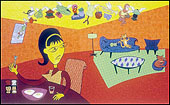 |
| Pam RuBert's 'Mysterious Migration of Miscellaneous Objects' |
GUILFORD — These sure ain’t your grandmother’s quilts!
Judging from the inclusions in the current exhibit at the Guilford Handcraft Center, "Mixed Media Quilts," one would be hard-pressed to relate these 21st-century creations to the old-fashioned quilt genre to which one is accustomed.
Traditionally defined as a technique of stitching two layers of fabric together with an additional thin layer between them, quilting, a very old art form, arrived in Europe at the time of the Crusades.
English colonists brought the technique to the New World, where, in the 18th century, Americans began to make quilted bedcovers out of leftover scraps of fabric. Given the passage of time and the varying sensibilities and needs of different groups, the art of quilting evolved from its formative functional roots into a multifaceted contemporary craft of varying aesthetic and use.
Today’s artists, as evidenced by the works of the 32 artists selected for this show from across the country, have clearly extended the definition of a quilt, visually, tactilely and even emotionally, with varying degrees of effectiveness.
Material, technique, size, dimension, form and execution have all been stretched to a point that completely redefines quilting’s concept, often to a point where one is hard-pressed to connect anything about contemporary quilt-making to its origins.
In fact, some of the quilts appear to make no reference to quilting at all. Others give nominal nods to some aspect of process or format.
The construction, flexibility, softness, layering, design and the appeal of fabric usually associated with the medium seem to have gone the way of snuggling up by the fire wrapped in a soft and comforting quilt.
Some of the works, often made of hard objects like wood, glass, ceramic tile or paper, while referencing aspects of quiltedness, like a patchwork grid-like format or an obligatory row of stitches, for example, are far more recognizable as assemblages or sculptures than as anything remotely quiltlike.
Another surprising aspect here is the relative smallness of many of the works, an aspect that too appears to go against the grain of quilting. While the artists appear poised on one level to push the parameters of their genre, on another level, the relative diminutiveness of many of the works seems to convey a certain timidity and ambivalence associated with that new direction.
Nevertheless, the show includes some fine pieces that are both quiltlike and contemporary.
Ann Baddeley Keister’s "Spin" is a lovely large cotton and glass bead work in which the artist combines skillful craft and evocative narrative to form a work of clear direction and basic beauty.
Colorful shapes, varied patterns, intricate beading, all blend with a compelling and subtle narrative that addresses the complexities of war, neither aspect detracting from the quality of the craft nor the beauty of the design.
Pamela Erickson’s "Ticket Quilt" is a wonderfully imaginative wall hanging composed of paper tickets and thread, in which the narrative speaks to the use of tickets as admittance to events and places.
Although Erickson works with materials not associated with the quilt genre, she does so in a manner that pays thoughtful homage to its form and its flexibility.
Suzanne R. Neusner’s "Topography" is a small work in which the artist fashions an aerial landscape view. While Neusner retains the surface, textural appeal and tactility one associates with traditional quilt making, she adds sculptural elements that give the work a sense of narrative, movement and dimension.
Keister, Erickson and Neusner are all prizewinners here.
In another interesting piece, "Peacock Feathers," Mary Craik investigates the relationship between the contemporary and traditional modes of process, printing digital imagery upon a surface of traditionally stitched quilted channels.
A couple of whimsical pieces catch one’s attention.
Pam Rubert’s "Mysterious Migration of Miscellaneous Objects" is a colorful, entertaining cartoon-like stitched quilt with an appealing narrative and openness and a charming homespun quality.
Jill Rumoshosky Werner’s "Extruded" takes an interesting turn in which pieces of quilting material are extruded from a form made of quilting batting, making a tongue-in-cheek comment, it appears, to both process and material.
And then there’s Sharon Hirsch’s "Tracks in the Snow," a glittering melange of pearls and patches, that feels like a breath of warmth and comfort among all the coolness that abounds here.
The show was juried by Ed Johnetta Miller and Jan Baker, both artists, teachers and curators.
By the way, according to a listing of the show’s participants, one can’t help but note that there are only a couple of men included here, which leads one to conclude that quilting, no matter the form or direction, still remains largely woman’s work.
Judy Birke of New Haven is a freelance writer and art consultant.
|

